

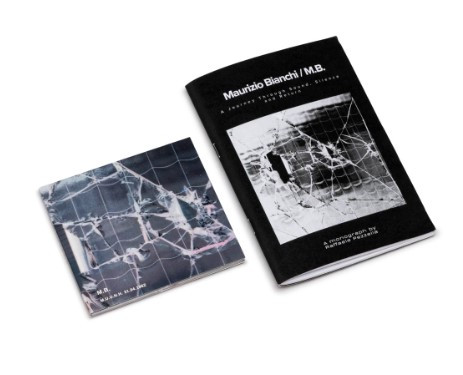
On the printed side, Raffaele Pezzella traces Maurizio Bianchi’s (M.B.) path from the marginal yet fervent Italian industrial underground of the early 1980s to his sudden disappearance and cautious re-emergence decades later. His narrative shows how those early tapes and LPs were forged in near-complete isolation, using primitive electronics and tape processes to produce works that treated noise, repetition and subtraction as a form of spiritual and aesthetic discipline. The book lingers on the pivotal decision to abandon music altogether, reading Bianchi’s withdrawal not as a retreat but as the logical extension of his subtractive method. By the time it reaches his return, the reader understands that every new recording must reckon with the silence that preceded it.
The M.U.U.N.H. 31.04.1982 CD supplies the raw sonic evidence that Pezzella’s prose circles around. Recorded at a moment when Bianchi’s approach was crystallizing into its most unforgiving form, the album presents sound as a static, high-tension field rather than a narrative flow: electronics and tape manipulation reduced to bare impulses, minimal variations stretched until they acquire an almost unbearable psychological weight. There is no catharsis here, no melodic release - only a suspended, impersonal presence that forces the listener into direct confrontation with the material itself. Heard alongside the monograph, the work ceases to be an opaque relic of early industrial and becomes a living case study in the extremes of artistic intent.
The reissue, restored with care, preserves the original’s austerity while recovering detail and depth, allowing the harsh planes and low-level shifts of M.U.U.N.H. 31.04.1982 to emerge with renewed clarity. In parallel, the book situates that sound within a broader landscape of underground circulation, small-run cassettes and personal conviction, revealing how an isolated Italian artist helped prefigure isolationist ambient, dark drone and later strands of reductionist noise without ever smoothing his work into a digestible style. Together, they offer both context and immersion: the monograph gives the tools to read Bianchi’s practice, the album provides the unmediated experience that resists being fully explained.


